
India will celebrate its 80th Independence Day on 15 August 2026, marking the country’s freedom from British rule in 1947. Independence Day is a special occasion for every Indian as it reminds us of the courage, unity, and sacrifices of countless freedom fighters. Many brave men and women gave their lives and faced great difficulties to help India become a free nation after nearly two centuries of British rule. The day is celebrated with great pride and patriotism across the country. Schools, offices, and public places are decorated with the national flag, and people take part in cultural programmes and patriotic activities.
On Independence Day, the Prime Minister of India hoists the national flag at the Red Fort in Delhi and addresses the nation. The Indian National Flag, popularly known as the Tiranga, has three horizontal colours—saffron, white, and green. The Ashoka Chakra, a navy-blue wheel with 24 spokes, is placed at the centre of the white band. The Tiranga is a symbol of India’s pride, unity, courage, and peace. It also has an important place in the country’s freedom struggle. As India prepares to celebrate Independence Day on 15 August, it is a wonderful time to learn more about the history and importance of our national flag and remember the sacrifices of those who fought for our freedom.
Discover the Interesting History of the National Flag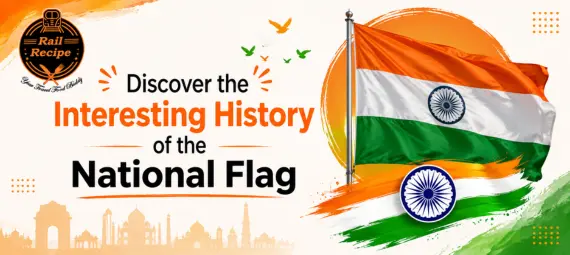
1.The first unofficial flag of India was hoisted on 7 August 1906 at Parsi Bagan Square in Calcutta, now Kolkata. It had three horizontal stripes in red, yellow, and green. The words “Vande Mataram” were written in the middle. This flag was an early symbol of India’s freedom struggle.
2.Madam Bhikaji Cama was the first person to unfurl an early version of the Indian national flag on foreign land. She proudly displayed the flag on 22 August 1907 at the International Socialist Congress in Stuttgart, Germany. Her act became an important moment in India’s freedom struggle.
3.In 1917, Bal Gangadhar Tilak hoisted a new type of Indian flag. It had red and green stripes, with the Union Jack in the top-left corner and a crescent in the top-right. The flag also featured seven stars arranged in the shape of the Saptarishi constellation, representing an important period in India’s freedom struggle.
4.In 1921, a new Indian flag was designed based on Mahatma Gandhi’s vision. It had three colours: white at the top for religious minorities, green in the middle for Muslims, and red at the bottom for Hindus. A spinning wheel (Charkha) was placed in the centre, symbolising self-reliance and the freedom movement.
5.In 1921, another version of the Indian flag was introduced and adopted by the Congress Committee. It had saffron at the top, white in the middle, and green at the bottom, with a spinning wheel in the centre. This flag became an important step toward the design of our present-day national Tricolour.
6.The Indian National Flag that we use today was designed by Pingali Venkayya, a freedom fighter and educationist from Andhra Pradesh. He played an important role in creating the design of the Tricolour. His contribution became a memorable part of India’s history and the country’s journey towards independence.
7.Before 2002, ordinary citizens in India could generally hoist the National Flag only on special occasions like Independence Day and Republic Day. In 2002, the Supreme Court changed the rules related to the Flag Code, allowing citizens to hoist the National Flag on other days as well, while following the proper rules and showing respect.
8.The present Indian National Flag has three colours—saffron, white, and green. Saffron stands for courage and sacrifice, while white represents peace, honesty, and purity. Green represents prosperity and growth. At the centre is the Ashoka Chakra, a navy-blue wheel with 24 spokes that represents the continuous cycle of life and progress.
9.The Karnataka Khadi Gramodyoga Samyukta Sangha in Hubli has been authorized to manufacture the Indian National Flag. The flag must be made using Khadi fabric as per the prescribed rules. Making or using a National Flag from unauthorized materials can lead to legal action, including imprisonment of up to three years.
10.According to the Flag Code, the Indian National Flag should be hoisted during the daytime and must always be treated with respect. No other flag or symbol should be placed above it. The flag should be displayed horizontally, with the saffron colour at the top, followed by white and green.
How to Book Food on Train While Traveling on Independence Day 2026
If you are planning a train journey on Independence Day? Make your trip more enjoyable by ordering fresh and tasty food on train with RailRecipe. You can easily book your favorite meal online and get it delivered to your seat at selected railway stations. Choose from a variety of food options, including biryani, thali, dosa, Chinese food, snacks, and more. To order your meal, simply download the RailRecipe Android or iOS app, enter your journey details, select your preferred food, and place your order. You can also call us at our toll-free number 8448440386 to book your meal on train. Enjoy convenient food delivery during your Independence Day journey and get exciting offers on every order. Celebrate the journey with delicious food and great savings.