
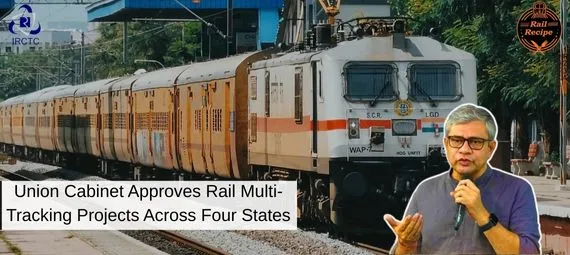
The Union Cabinet on Economic Affairs for approved four multi-tracking projects spanning 18 districts across Maharashtra, Madhya Pradesh, Gujarat, and Chhattisgarh, adding about 894 km to the Indian Railways network. The projects are to be developed at a cost of ₹24,634 cr by 2030-2031.The Cabinet Committee on Economic Affairs, chaired by the Prime Minister Shri Narendra Modi,has approved Four projects of Ministry of Railways with total cost of Rs. 24,634 crore (approx.). These projects include:
Four States to Get New Rail Lines After Union Cabinet Approval
Wardha – Bhusawal – 3rd & 4th line – 314 kms (Maharashtra)
Gondia – Dongargarh – 4th line – 84 kms (Maharashtra & Chhattisgarh)
Vadodara – Ratlam – 3rd & 4th line – 259 kms (Gujarat & Madhya Pradesh)
Itarsi – Bhopal – Bina 4th line – 237 kms. (Madhya Pradesh)
The four projects covering 18 Districts across the states of Maharashtra, Madhya Pradesh, Gujarat, and Chhattisgarh will increase the existing network of Indian Railways by about 894 Kms.
How New Rail Projects Will Improve Train Travel and Boost Growth
These multi-tracking projects are an important step towards strengthening India’s railway infrastructure. By adding third and fourth lines on busy routes, Indian Railways will be able to run more passenger and freight trains smoothly. This will help reduce delays, ease congestion, and improve overall train punctuality. With higher line capacity, train movement will become faster and more reliable for passengers as well as businesses that depend on rail transport.
The increased line capacity will significantly enhance mobility, resulting in improved operational efficiency and service reliability for Indian Railways. These multi-tracking proposals are poised to streamline operations and alleviate congestion. The projects are in line with the Prime Minister Shri Narendra Modiji’s Vision of a New India which will make people of the region “Atmanirbhar” by way of comprehensive development in the area which will enhance their employment/ self-employment opportunities.
Railway Expansion to Reduce Delays, Support Economy, and Improve Passenger Comforts
Better railway connectivity also supports economic growth. These union cabinet approves these routes that pass through industrial, agricultural, and mineral-rich regions. With improved rail lines, transportation of goods such as coal, cement, food grains, and other essential items will become faster and more cost-effective. This will benefit industries, farmers, and traders while also helping reduce pressure on road transport.
The projects are planned on PM-Gati Shakti National Master Plan with focus on enhancing multi-modal connectivity & logistic efficiency through integrated planning and stakeholder consultations. These projects will provide seamless connectivity for movement of people, goods, and services.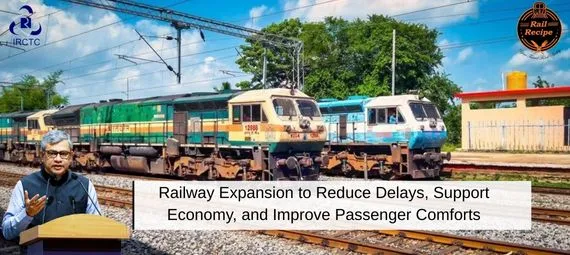
Under the PM Gati Shakti framework, railways are being developed in coordination with roads, ports, and logistics hubs. This integrated approach ensures better planning and long-term benefits for the country. Improved logistics efficiency will help lower transportation costs, boost exports, and support India’s growing economy.
Union cabinet Project section also provides rail connectivity to prominent destinations such as Sanchi, Satpura Tiger Reserve, Rock Shelter of Bhimbetka, Hazara Falls, Nawegaon National Park, etc., attracting tourists from across the country.
With better rail infrastructure, tourism in these regions is expected to grow. Tourists will find it easier to reach heritage sites, wildlife reserves, and natural attractions. This will create new opportunities for local businesses such as hotels, guides, transport services, and small vendors, generating employment at the grassroots level.