

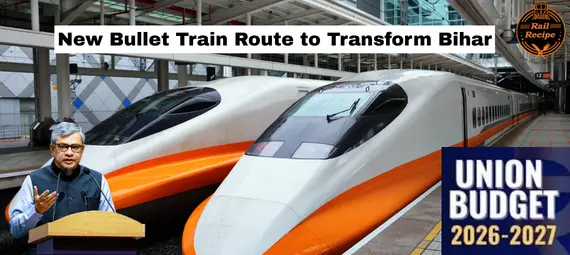
Union Railways Minister Ashwini Vaishnaw announced that Bihar will soon be part of India’s first new bullet train network. The new high-speed rail route will connect Varanasi to Siliguri and will pass through Patna as a major stop. This is the first time Bihar will be included in a bullet train project, marking an important step for the state’s railway development. The minister called the project a “game changer” and said it will modernize travel in the region. With faster trains and better facilities, passengers will be able to travel more comfortably and save significant time.
Vaishnaw said the Varanasi-Patna-Siliguri corridor will not only improve connectivity but also boost economic growth in Bihar and nearby areas. Better transport links are expected to attract new businesses, create job opportunities, and support trade and tourism. The project will also help in regional development by connecting important cities more efficiently. Improved rail infrastructure can make daily travel easier for thousands of people and strengthen ties between states. Overall, the bullet train corridor is seen as a major step toward progress and faster development in eastern India.
Varanasi–Siliguri Bullet Train Corridor to Transform Eastern India
The Varanasi–Siliguri High-Speed Rail Corridor is part of the Central Government’s big plan to build seven new bullet train routes across India. This corridor will pass through major cities in Bihar, including Patna and possibly Katihar, connecting Uttar Pradesh with West Bengal. For the first time, Bihar will be fully integrated into India’s growing high-speed rail network. Once the project is completed, travel time between Varanasi and Siliguri will be reduced from the current 14–18 hours to less than three hours. The trains are expected to run at speeds of 300 to 350 kilometers per hour, offering fast, safe, and modern travel for passengers.
Speaking about the proposed Delhi–Varanasi and Varanasi–Siliguri high-speed corridors, the railway minister said these routes will connect important cities of Uttar Pradesh and open new doors for economic growth. Faster connectivity will support trade, tourism, and job creation in the region. He also highlighted that under the Amrit Bharat Station Scheme, 157 railway stations are being redeveloped to improve passenger facilities. So far, four pairs of Amrit Bharat trains have started operations. These projects together show the government’s focus on strengthening railway infrastructure and promoting balanced regional development across the country.
A Record Budget Boost for Indian Railways and New Bullet Train Corridors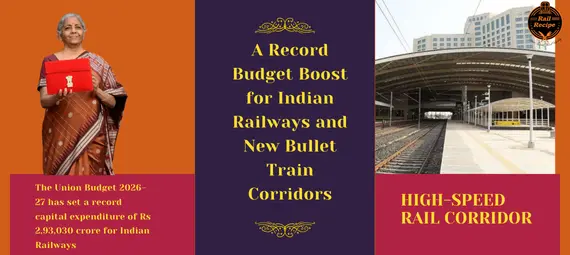
The Union Budget 2026–27 has set a record capital expenditure of Rs 2,93,030 crore for Indian Railways, the highest ever allocated to the sector. This huge investment shows the government’s strong focus on improving railway infrastructure and modernizing train travel across the country. As part of its long-term transport vision, the government has approved seven new high-speed rail corridors. These bullet train routes are planned as growth connectors to support fast, safe, and sustainable inter-city travel. The aim is to build a modern rail network that meets the needs of a growing population and expanding economy.
The proposed high-speed corridors include Mumbai–Pune, Pune–Hyderabad, Hyderabad–Bengaluru, Hyderabad–Chennai, Chennai–Bengaluru, Delhi–Varanasi, and Varanasi–Siliguri. These routes are expected to reduce travel time significantly and make long-distance journeys much faster and more comfortable. The corridors will also allow smooth connection with other modes of transport like metro, buses, and airports, ensuring seamless multimodal passenger movement. With better connectivity between major cities, these projects are likely to boost trade, tourism, and job creation. Overall, this record railway budget and the new bullet train plans mark a major step toward building a faster, greener, and more efficient transport system in India.
Frequently Ask Question for new bullet train route in Bihar